The sky has a new star, and it’s getting bigger. On Alarria, a world of glowing valleys and wildlife found nowhere else, the observatories have confirmed what nobody wanted to hear: the asteroid Leviathan is coming. How to Save a World, designed by Yuval Grinspun and published by Burnt Island Games, puts you in an orange flight suit as one of the scientists racing the clock. You’ll place your workers, build up your deck, bag and pool of resources, and push three desperate projects forward at once: a laser to shatter the rock, a shield to protect the planet, and, if all else fails, an evacuation to carry what you can off-world.
This one is a little different from our usual soundtracks. Instead of a slideshow, it’s an 80-minute animated mission: forty scenes painted in the game’s neon-lit style, brought to life with slow camera moves, drifting spores and embers, and a Mission Control display that counts down to impact across the whole video. The 40-minute score plays twice, and the first time, the finale is only a simulation.
🎶 The Soundtrack — Ten Movements Against the Clock
Ten original tracks follow the mission from the first sighting to the last light: warm analog synths, soft strings and slowly turning arpeggios, a cinematic sci-fi underscore made to sit quietly under the table talk. No vocals, no drops, nothing that jumps out while you’re counting resources.
- Dawn over Alarria — The opening. Soft felt piano and airy pads at an unhurried 70 bpm, with distant bells shimmering like light on wet leaves. A hopeful major key for a world that doesn’t yet know what’s coming; only a faint synth motif near the end hints at the streak in the sky.
- The Observatory — Night work. A soft ticking pulse, celesta and plucked synth arpeggios tracing orbits, with warm strings swelling beneath. Curious, focused music for the moment someone looks at the data twice and goes very quiet.
- Leviathan — The threat, kept at a distance. Deep, evolving drones in a minor key, far-off low brass and a slow heartbeat pulse at 60 bpm. Tension that never breaks the surface: vast, cold and patient as a rock crossing the dark.
- The Preserve — What you’re fighting for. Kalimba and marimba patterns, wooden flutes and light hand percussion over warm pads, playful and organic, like walking among creatures that have no idea there’s a countdown.
- Fortuna Moonbase — Low gravity, low pulse. Slow analog arpeggios, echoing clean guitar and a soft sub bass float at 76 bpm: weightless music for the moon base, where landers come and go and Alarria hangs huge in the black.
- The Laser Array — Resolve. A pulsing synth-bass ostinato locks in with driving strings at 96 bpm over the low hum of stored energy. The most determined piece in the score, yet still built for the background: it pushes, peaks, then settles into a calm afterglow.
- The Shield Lattice — Crystalline and protective. Glassy mallets and glockenspiel interlock like hexagonal plates clicking into place, wrapped in wordless, airy pads and slow, warm strings.
- Evac Shipyards — Hope, with cargo. Soft French horns, warm strings and a gently rising piano: quiet determination for loading ships with everything worth carrying away from a doomed world.
- Mission Control — Late night, coffee gone cold. Clock-like soft percussion, a low synth pulse and a lone cello melody at 72 bpm. Restrained tension that finally gives way to warm piano and calm resolve.
- Last Light — The finale, gentle rather than loud. Full, warm strings, piano and pads build to the score’s fullest moment in a hopeful major key, then resolve into serene stillness. Whatever happens on your table, the music lets it land softly.
🎨 The Art — Neon Under a Falling Sky
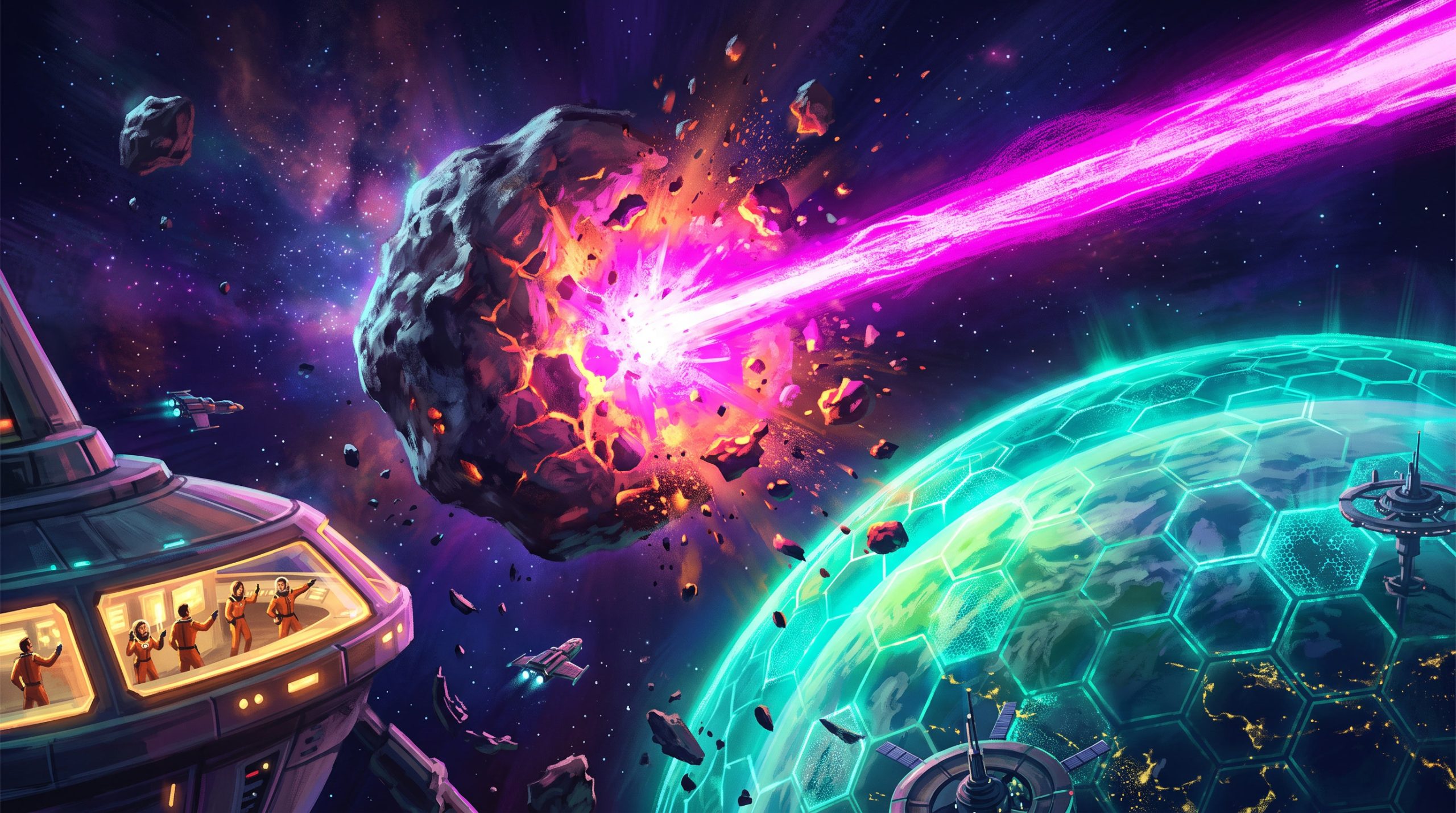
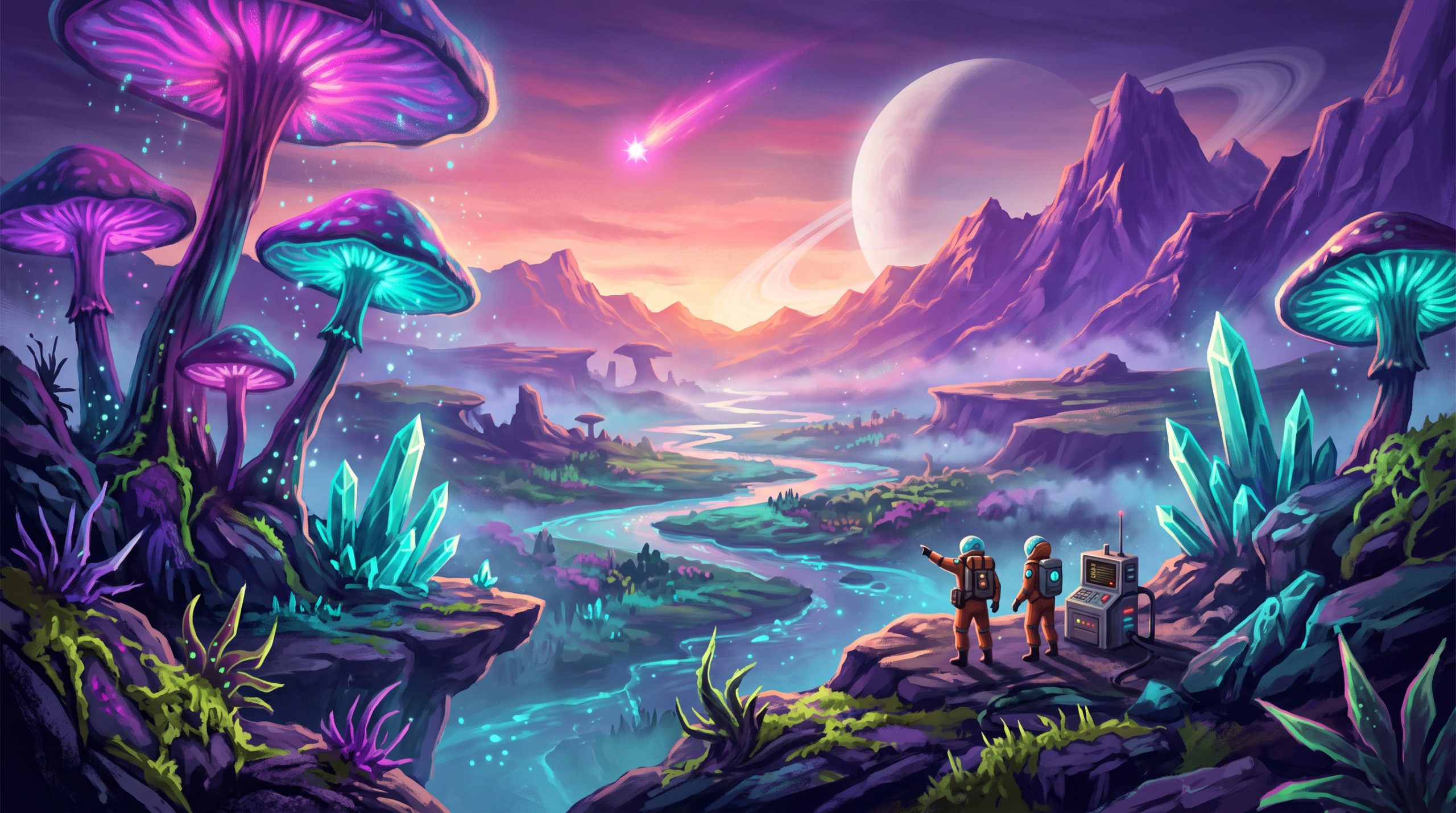
The AI-generated artwork leans into the game’s own look: painterly, retro-futurist sci-fi with deep indigo and violet shadows, lit by neon magenta, electric teal and acid-green glow, with orange flight suits in every crowd. Bioluminescent valleys, a domed preserve full of strange creatures, a moon base beneath a giant blue-green planet, laser gantries and a shimmering hexagonal shield. Every scene is built in layers, from the foreground to the far sky.
That depth is what brings it to life. Each painting becomes a layered scene the camera can drift through, push into and circle around, while particles float between the layers and Leviathan looms a little larger with every track. Over it all runs a mission display with original crew logs, scientist dossiers and project assessments that fill up as the countdown runs out.
🎬 Watch & Listen
Set the timer. Brew something strong. Let the soundtrack of How to Save a World keep Mission Control calm while you decide what gets built, what gets shielded and what gets saved, and find out whether your table can beat the clock before the last light.